How a Lemonade Stand Explains Tax Pooling Better Than Any Economics Class
Learn what taxes really are through Marcus's lemonade stand story. Discover how pooled public money builds the parks, roads, and schools that make everyday life possible.
Why Your Lemonade Stand Money Goes to Build Parks: A Simple Tax Story Most Adults Get Wrong
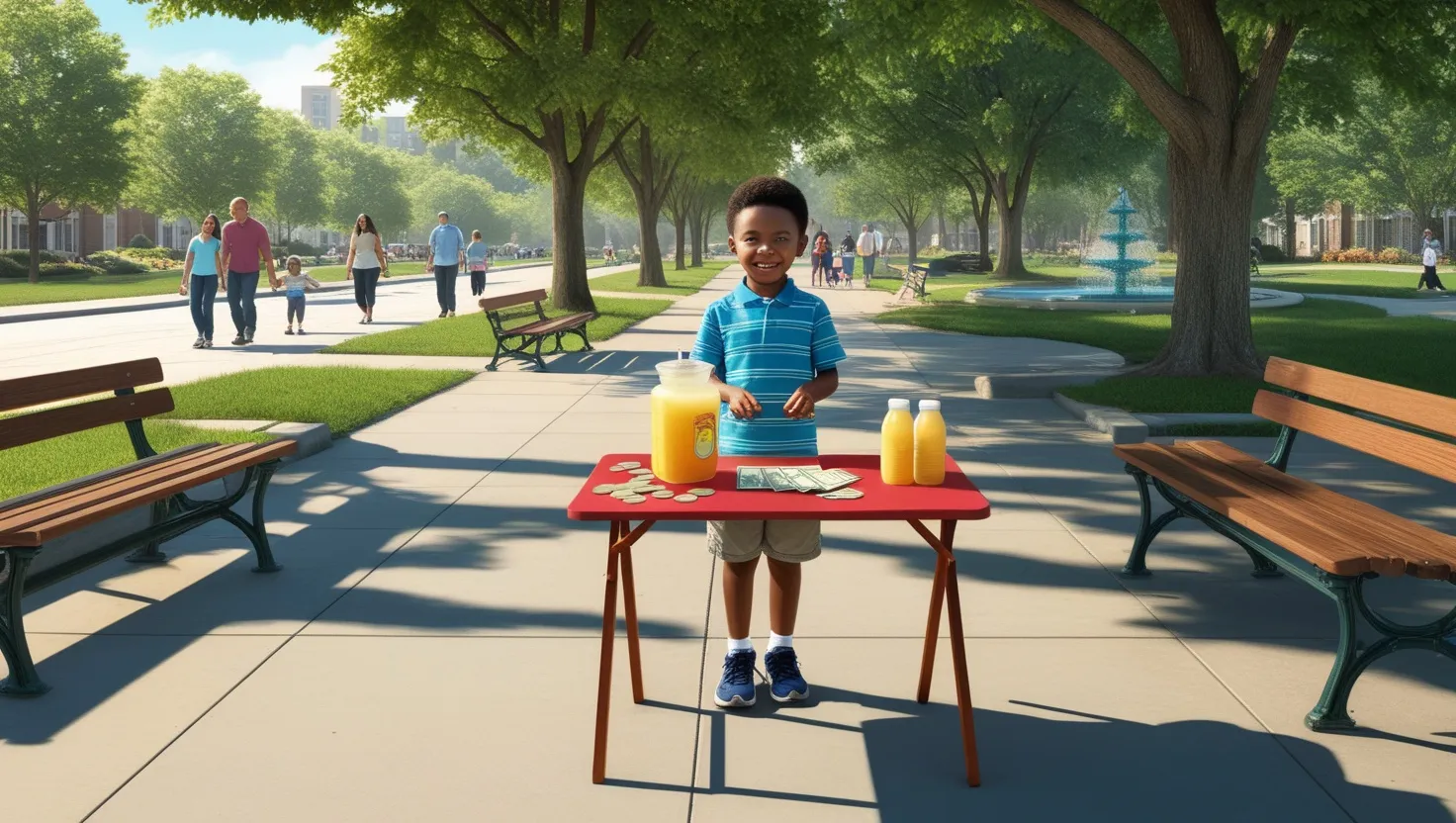
Picture this. It’s a hot Saturday afternoon. A nine-year-old boy named Marcus has been standing behind a folding table since ten in the morning, carefully pouring cups of lemonade for neighbors and strangers walking through the park. By three o’clock, he’s counted his coins and bills three times. He made fourteen dollars. Not bad for a kid with a pitcher and a hand-drawn sign.
Then his dad sits down next to him and says, “You know you’d have to pay taxes on that if you kept doing it, right?”
Marcus looks at his dad like he just said the sky is made of cheese.
This moment — a kid’s first collision with the idea of taxation — is one of the most universally mishandled conversations in family life. Most parents either wave it away or turn it into a political rant. But Marcus’s dad did something different. He told Marcus to look around. At the park.
Most of us were never properly taught what taxes actually are. We were told what they do — fund schools, pay soldiers, fix roads — but the deeper idea, the almost philosophical idea underneath all of it, was never explained simply. So let me do that now.
Taxes are pooled money. That’s it. Many people each put in a small amount, and that pool of money does something that none of them could do alone. The park Marcus was sitting in? Someone had to buy that land. Someone had to pour that concrete for the path. Someone had to plant those trees and install those benches and set up that water fountain that Marcus drank from twice that afternoon. No single family could afford that. But three thousand families each paying a fraction of it? Suddenly it becomes real.
“The art of taxation consists in so plucking the goose as to obtain the largest possible amount of feathers with the smallest possible amount of hissing.” — Jean-Baptiste Colbert
That’s the theory, at least. Whether governments always get the plucking part right is a whole other conversation.
Here’s something most people don’t think about: Marcus didn’t just sell lemonade in an empty field. He sold lemonade in a park — a park with foot traffic, shade trees, clean pathways, and a safe, pleasant environment. That environment was created by collective investment. In a real sense, the park made his lemonade stand possible. Without it, he’d be standing in a dirt lot on a dead street.
This is what economists call the “public goods” problem, and it’s more interesting than it sounds. Some things simply cannot be provided by private businesses because there’s no clean way to charge only the people who use them. You can’t put a toll booth at every tree. You can’t charge someone for breathing park air. So everyone chips in, and everyone benefits — including small entrepreneurs with lemonade stands.
Have you ever thought about how many things in your average Tuesday were built by pooled public money? The road you drove on, the traffic light that stopped you from getting hit by a truck, the school your kid walked to, the sidewalk you didn’t even notice — all of it came from the same basic idea Marcus’s dad was explaining with a wave of his hand around that park.
The history of tax pooling is surprisingly human. The oldest known tax records come from ancient Sumer, around 3000 BCE — clay tablets recording grain contributions from farmers. The grain went into a central store, and from that store, workers building public infrastructure were fed and paid. It wasn’t called “tax” yet, but the logic was identical. You give a bit of what you have, and something bigger gets built.
Ancient Athens ran its public festivals, its navy, and its courts through a system where wealthy citizens were expected to fund specific public projects — a practice called “liturgy.” It wasn’t voluntary in the way we might like to imagine. Social pressure and legal obligation kept it moving. But the result was a city that had public buildings, theater, civic life — things that made Athens, Athens.
“Taxes are what we pay for a civilized society.” — Oliver Wendell Holmes Jr., carved into the facade of the IRS building in Washington, D.C.
Even the man whose institution we most associate with tax pain thought it was worth saying out loud on a building.
Now, here’s where it gets genuinely interesting — the part that most people miss entirely.
Tax pooling doesn’t just build things. It coordinates things that would otherwise collapse under what economists call the “free rider problem.” Think about Marcus again. If paying for the park were voluntary, many families would think, “Someone else will pay for it. I’ll just show up.” If enough families think that way, no one pays, and there’s no park. The mandatory nature of taxation is actually what makes the whole thing function. Compulsion sounds harsh, but it’s the mechanism that makes collective action possible at scale.
This is also why ancient Roman aqueducts got built and why your city has fire stations. No individual has strong enough incentive to fund a fire station alone. But when a neighborhood is on fire, everyone benefits from having one.
What did Marcus’s dad actually say to him that afternoon? He pointed at a bronze plaque near the park’s entrance — the kind nobody reads — that listed the year the park was established and the names of the city council members who approved its funding. “This park,” his dad said, “was built before either of us was born, by people we’ll never meet, using money from thousands of families who wanted something better for the neighborhood. And you sold fourteen dollars worth of lemonade standing in it today.”
Marcus thought about that for a second. Then he asked: “So the park made me money?”
Yes. Exactly. The park made him money.
Let’s ask a harder question: does everyone benefit equally from pooled tax money? Honestly, no. And pretending otherwise would be dishonest. Tax systems are imperfect. Money is sometimes wasted, misspent, or directed toward projects that serve some groups far more than others. The history of public infrastructure is also, partly, a history of who got the park and who got the highway ramp.
But the answer to an imperfect system is almost never “no system.” The answer is a better, more accountable system. A park that only serves one neighborhood is still better than no park at all — it just isn’t as good as a system where resources are distributed with more care and fairness.
“We do not inherit the earth from our ancestors; we borrow it from our children.” — Often attributed to Antoine de Saint-Exupéry
This quote usually appears in environmental discussions, but it applies perfectly to infrastructure and taxation too. Every park, every school, every bridge was paid for by people who built something for people they would never see use it. Marcus will one day pay taxes. Some of that money will build something for children he hasn’t met yet, in neighborhoods he may never visit.
There’s a quiet, almost invisible generosity in tax pooling that rarely gets acknowledged. When you pay your property tax, you’re partly paying for a school you may have no children in. When you pay into a public health system, you’re partly paying for treatments for strangers. This isn’t charity — you don’t get to choose, and you don’t get a thank-you note. It’s something closer to civic responsibility, which is a less glamorous but perhaps more honest version of generosity.
Marcus, at nine years old, understood something by the end of that afternoon that plenty of adults never quite grasp. His fourteen dollars came from individual customers, yes. But his ability to earn fourteen dollars came from a much larger, older, collective act of investment in a shared space.
So the next time someone complains that taxes take money away, remember Marcus standing in his park. The money didn’t just disappear. It was already there, poured into the concrete under his feet, rooted in the trees giving him shade, flowing through the fountain he drank from twice.
He didn’t build that park. But he benefited from it. And someday, the taxes he pays will build someone else’s park, in someone else’s neighborhood, on a hot Saturday afternoon that neither of them will share.
That’s tax pooling. That’s the quiet, collective reward. And it’s been working, imperfectly but persistently, since someone in ancient Sumer picked up a chisel and recorded the first grain contribution on a clay tablet.
Not bad for a concept most people write off as just the government taking your money.