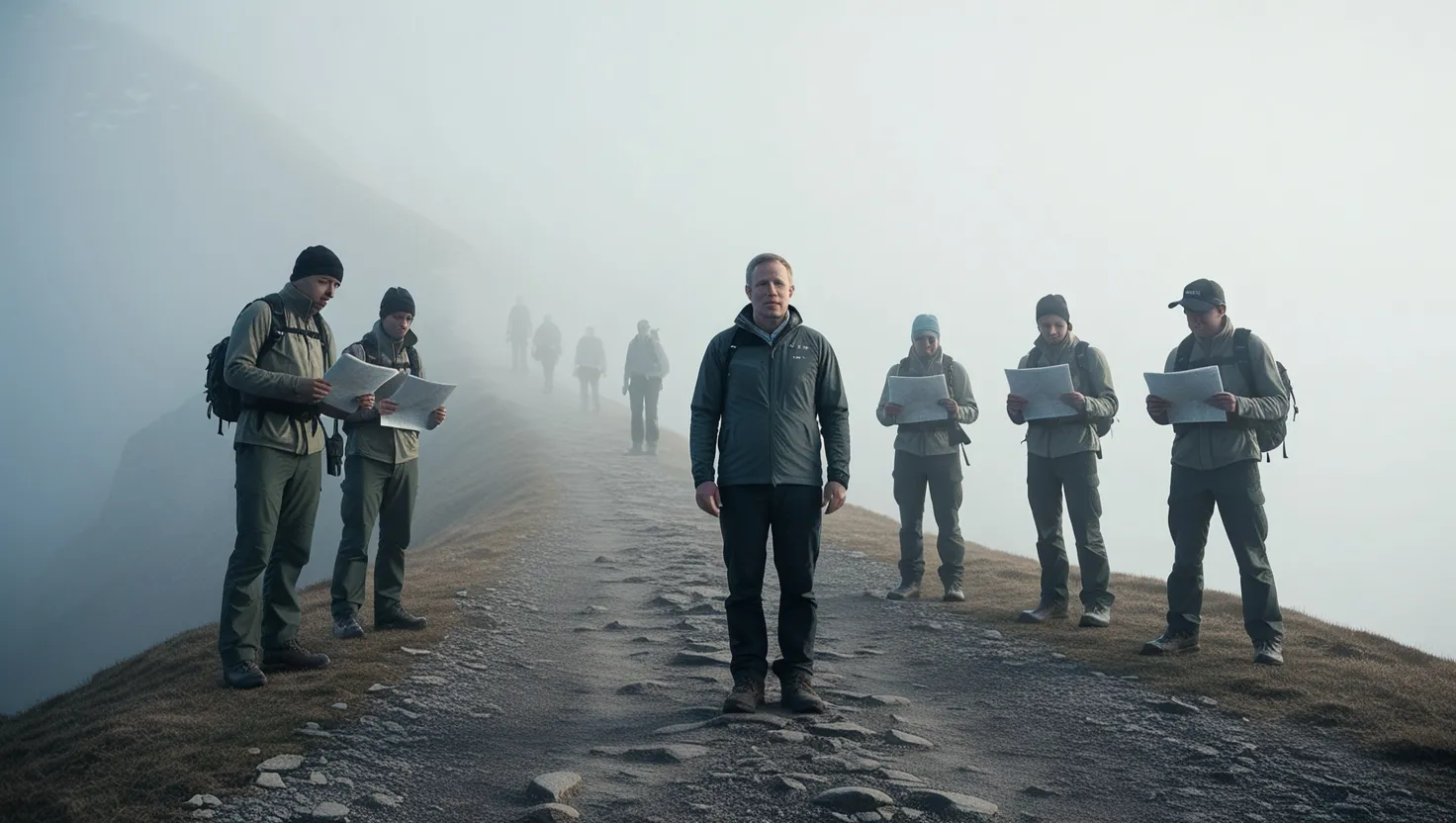
Most people think leadership is about big speeches, bold moves, and dramatic turnarounds. I want to talk about the part no one posts on LinkedIn: the long, slow, boring middle where nothing seems to move, no one is impressed, and everyone is a little tired of the whole thing.
If you’ve ever started a new project with energy and clear purpose, only to feel stuck months later, you already know this place. The start is exciting. The end is satisfying. The stretch in between is where leaders are quietly made or quietly fail.
Let’s walk through that space together in simple words.
The middle starts the moment the “new” wears off. The dashboards flatten. The “quick wins” are done. The big blockers show up. People stop asking, “How can I help?” and start asking, “How much longer is this going to take?” Have you seen that shift in a team’s eyes before?
In that moment, many leaders secretly panic. Some blame the team: “They’ve lost motivation.” Some blame the plan: “Maybe this whole thing was a bad idea.” Some just push harder and louder, hoping more pressure will produce more progress.
It usually doesn’t.
The real problem is not laziness or bad people. The real problem is invisible progress. When effort is high and visible, but progress is slow and hard to see, the brain reads it as “pointless.” People do not quit when things are hard. They quit when hard things look pointless.
So in the dull middle, your main job as a leader is simple: make progress visible again.
That sounds fancy, but it starts with small things. Instead of saying, “We are still far from the goal,” I might say, “Last month we had no idea how to fix this. Today we have three options we did not have before.” Same reality, different frame. One sounds stuck. The other sounds like movement.
Have you ever noticed how a fitness app celebrates tiny steps, even when you’re nowhere near your health goal? It is not because 3,000 steps are amazing. It’s because your brain needs proof that effort matters. Your team is no different.
In the middle, I like to shrink the game. Big targets still matter, but I bring the focus down to what we can win this week. Not vague “improvement,” but things like:
Instead of “fix customer experience,” it becomes “cut average response time by 10 seconds by Friday.”
Instead of “transform the culture,” it becomes “get one frontline idea tested in the next 7 days.”
Small targets feel reachable. Reachable wins renew energy. Energy fuels the next step. Step by step, the middle becomes less dull and more like a quiet training ground.
There is another thing happening in the middle that we often ignore. Boredom is not just boredom. It is often grief in disguise. At the start, people imagine a perfect version of the future. By the middle, they have discovered limits, trade-offs, and delays. The dream they had at the start has died a little.
If I pretend nothing has changed, I lose trust. So I name it. I might say to the team, “We thought we’d be further along by now. It’s okay to feel disappointed. That doesn’t mean this is not worth doing.” Simple words. Honest feelings. People do not need you to be a hero. They need you to be honest without giving up.
This is where a famous line from Winston Churchill helps me:
“If you are going through hell, keep going.”
I do not use this line to sound smart. I use it as a reminder to myself: the only real failure in the middle is to stop for the wrong reasons. The trick is to “keep going” in a smart, not stubborn, way.
The middle is also where habits quietly beat hype. At the start, people rely on emotion. They are excited, scared, or proud. In the middle, those feelings fade. What is left is what we do on autopilot. So I pay more attention to routines than to speeches.
Ask yourself: if no one was “motivated” on my team, what would still happen every day? Whatever the answer is—that is your true system. If that system does not support the goal, no amount of pep talks will save you.
So instead of chasing constant inspiration, I try to tune the daily rhythm. Short, focused check-ins instead of endless meetings. Simple visual boards instead of 40-slide decks. Rotating who leads the standup so it does not always feel like “the boss talking.” None of this is flashy. But the middle is where quiet structure beats noisy passion.
This is also the best time to share the boring truth about real progress: it often looks like circles, not straight lines. We experiment, mess up, adjust, and try again. From inside, it can feel like you’re just spinning. From above, you can see the circles are slowly moving forward.
That is why I like to ask the team questions like:
“What can we do wrong faster and cheaper this week?”
“What did we learn this month that we did not know three months ago?”
Those questions turn “we failed” into “we paid for new information.” The work has value again.
Now, there is a quiet danger in the middle: fake progress. Fake progress is when we are busy, tired, and full of reports, but nothing important is truly changing. Have you seen a project like that?
As a leader, I have to be brave enough to pause and ask, “If we keep working exactly like this for another six months, will the world outside actually notice a difference?” If the honest answer is no, we are stuck in motion, not progress.
This is not the time to blame. It is the time to prune. Cut work that does not move the needle. Merge meetings. Stop useless reports. Free up time for the few actions that matter. The middle is a perfect time to remove things that looked good in the kickoff deck but have turned out to be noise.
Another useful idea in this phase is role rotation. People get stale doing the same part of the work the same way every day. When possible, I like to rotate responsibilities inside the team in small ways.
The analyst runs the meeting. The junior developer presents to the stakeholder. The quiet person owns a small cross-team task. Not because I want to “shake things up” for fun, but because fresh eyes see new problems, and new problems bring fresh interest.
It is similar to rearranging a room you’ve lived in for years. Same furniture. New flow. Suddenly you notice things you had stopped seeing.
A quote often shared in this context comes from John Maxwell:
“The pessimist complains about the wind. The optimist expects it to change. The leader adjusts the sails.”
The middle is where you adjust the sails again and again. Not with drama. Just with steady, patient tweaks.
One of the most powerful but neglected tools in this phase is how we speak about the work when no one is watching. If I complain about the project to my peers, if I roll my eyes at change requests, I silently train others to treat the mission as a burden. Even if I say all the right things in public, my private tone will leak out.
So I keep asking myself, “If someone recorded how I talk about this project in private, would my team still trust that I believe in it?” That question keeps me honest.
It also helps to talk less about “the project” and more about “the people served.” In the middle, the project often becomes an abstract monster: deadlines, budgets, metrics. People forget why we started. I try to bring in real stories—one customer, one patient, one student, one user.
For example, instead of saying, “We have to hit this release date,” I say, “There is a person out there who is waiting for this fix so they don’t have to call support three times a week. Let’s get it to them faster.” Simple. Human. Concrete.
There is a short quote from Simon Sinek that sums this up well:
“People don’t buy what you do; they buy why you do it.”
In the middle, our “why” does not change, but it does fade in people’s minds. So I treat it like a fire that needs small, regular logs. Not a one-time flame at the kickoff.
Of course, there is also the topic of recognition. Everyone says, “Celebrate small wins.” The problem is many leaders only celebrate visible, external wins—revenue, awards, big launches. In the middle, those may not exist yet. So I try to celebrate behaviors, not just outcomes.
Someone cleaned up a messy process no one saw? I call it out.
Someone spoke up early about a risk that saved us pain later? I thank them in front of others.
Someone admitted a mistake quickly so we could fix it fast? I label that as courage, not failure.
When I do this, I am not just being “nice.” I am telling the group, “This is what good looks like here.” Over time, that becomes culture. And culture is what carries you when mood and motivation are low.
Let me ask you: in your current work, what is one “quiet win” you could recognize this week that almost no one else has noticed?
One more hard truth about the dull middle: sometimes, the right leadership move is to change the finish line. Plans made at the start were guesses, made with limited data. By the middle, we know more. Sticking to a bad target just to “stay consistent” is not leadership. It is pride.
When I adjust goals mid-course, I try to be very clear about three simple things:
What has changed.
What we have learned.
What this means we will do differently.
If I skip any of these, people feel whiplash. But if I walk them through the story plainly, most adults are reasonable. They do not mind change. They mind confusion and hidden agendas.
In those moments, I think of a line often tied to Peter Drucker:
“Plans are only good intentions unless they immediately degenerate into hard work.”
The middle is where “good intentions” either turn into that hard work or fall apart. Adjusting is not a sign of failure. It is a sign that the hard work is real, not theoretical.
You might be wondering, “Do I need to be some kind of superhuman to lead well in this phase?” No. In fact, the middle is often where quieter, less charismatic people make their biggest impact. It rewards leaders who are:
Patient enough to stick around when the spotlight is gone.
Curious enough to keep asking, “What’s really happening here?”
Humble enough to say, “We misjudged this part; let’s fix it.”
Brave enough to cut work that only exists to make us look busy.
If you are not a natural cheerleader, the middle can actually be your zone. You can be the person who holds the line, keeps the promises, and does not vanish when applause stops.
So, let me ask you a final set of questions:
Where in your world right now are you in that long, dull stretch?
What small, real progress have you quietly made that you have not named?
What could you shrink, simplify, or rotate this week to make the work feel fresh again?
And most important: what “why” did you start with that you have not talked about in a long time?
Leadership in the dull middle is not about big heroic moments. It is about steady eyes, honest words, and simple, repeatable acts that keep a group moving when no one is watching.
Anyone can look like a leader at the kickoff party or at the final celebration. If you want to test the quality of your leadership, look at what happens in those gray weeks where every day feels the same.
If your team still knows the purpose, still sees real progress in small steps, still feels seen for their effort, and still believes you are in it with them, then you are leading well where it matters most: in the quiet middle that actually builds the future.