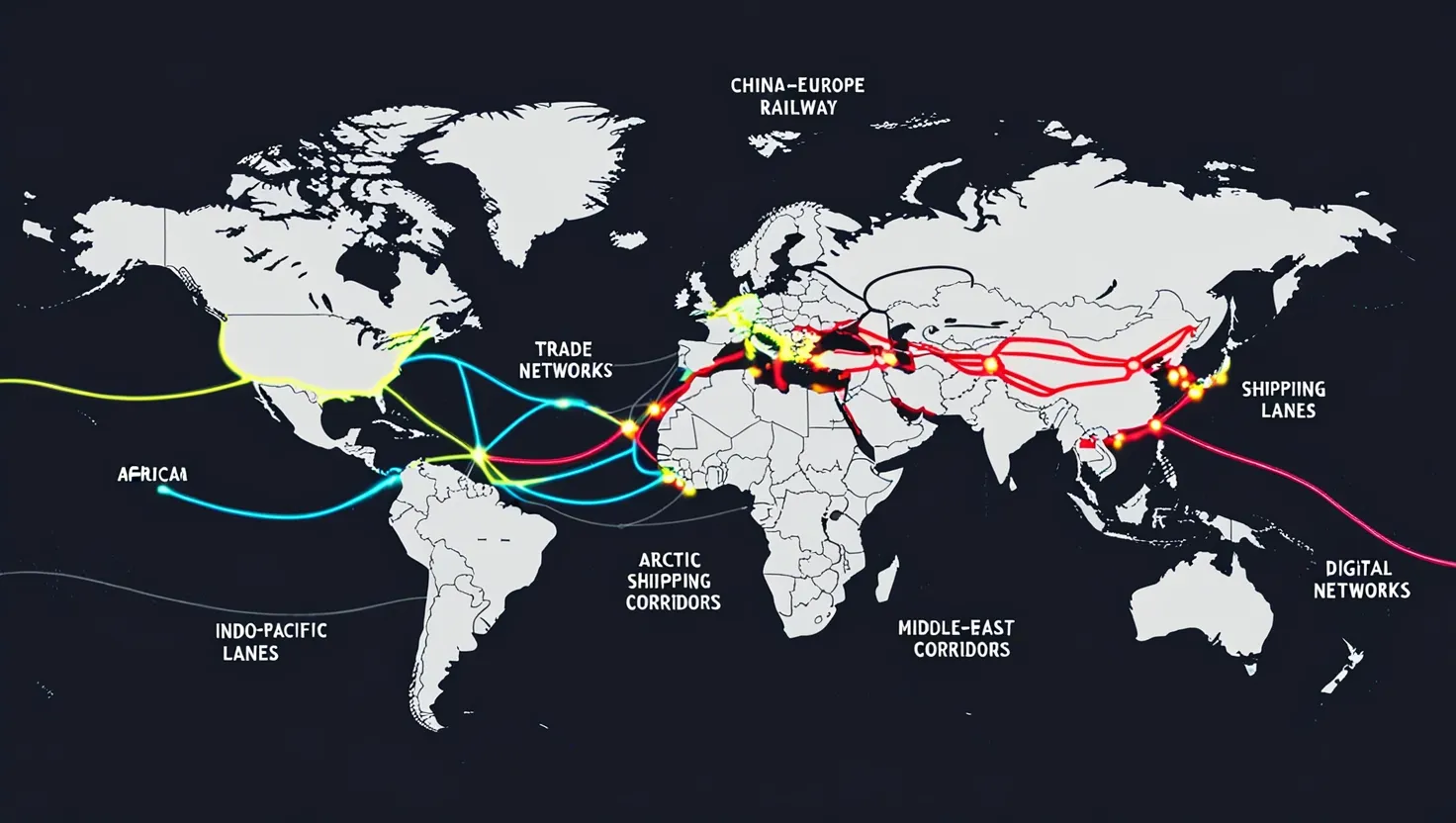
Who Controls Human Movement? The 5 Global Frameworks Shaping Migration Law Today
Learn how five major international migration frameworks — from the 1951 Refugee Convention to bilateral labour deals — shape who gets to move and who gets left behind.
Over 280 million people currently live outside the country where they were born. That number is larger than the entire population of Brazil. Yet despite this scale, the rules governing how people move across international borders remain a patchwork of old treaties, regional deals, non-binding agreements, and bilateral contracts — many of which were written for a world that no longer exists.
Think of it this way: the primary global rulebook for protecting people who flee their countries was written in 1951, when the Soviet Union was the main geopolitical threat and climate change wasn’t even a policy conversation. We’ve sent humans to space, mapped the human genome, and built the internet since then — but the foundational document governing refugee protection has barely changed.
So who actually decides who gets to move, where they go, and what happens to them when they get there? The answer involves five major frameworks, each with its own logic, its own flaws, and its own very real consequences for millions of people.
The 1951 Refugee Convention — A Brilliant Document Showing Its Age
The UN Refugee Convention was written in the aftermath of World War II. Europe was full of displaced people, and the international community needed a legal definition of who counted as a refugee. The answer they arrived at was someone fleeing persecution based on race, religion, nationality, political opinion, or membership in a social group.
That definition was specific, deliberate, and — for its time — revolutionary. The principle of non-refoulement, which means a country cannot send someone back to a place where they face serious harm, became one of the cornerstones of international human rights law.
“No one leaves home unless home is the mouth of a shark.” — Warsan Shire
Here’s where the problem starts, though. What about someone fleeing a flood that wiped out their entire village? Or someone whose island nation is literally sinking into the Pacific Ocean due to rising sea levels? The 1951 Convention says nothing about them. Climate displacement, which already affects tens of millions of people annually and is projected to displace hundreds of millions more by 2050, exists in a legal grey zone. These people are not refugees under international law. They are not economic migrants with labor rights. They are, in bureaucratic terms, almost nobody.
Ask yourself: if your home becomes permanently uninhabitable not because of war but because of a disaster you didn’t cause, should international law protect you any less?
The Global Compact for Migration — Ambition Without Teeth
In 2018, after years of negotiations, 152 countries signed the Global Compact for Safe, Orderly and Regular Migration. On paper, it looked like a milestone. For the first time, the international community had a comprehensive document covering the full spectrum of migration — from labor mobility to smuggling to migrant rights.
The catch? It’s non-binding. Not a single country can be held legally accountable for violating it.
Several governments — the United States under Trump, Hungary, Poland, Australia — either refused to sign or withdrew, citing concerns about national sovereignty. Their argument was essentially that a country’s right to control its own borders shouldn’t be subject to international oversight. That argument has intuitive appeal, but it also conveniently sidesteps the question of what happens to the people caught between borders.
“We are all migrants through time.” — Mohsin Hamid
The Compact’s real value isn’t legal enforcement — it’s the shared language it created. It established 23 specific objectives, including reducing irregular migration, fighting trafficking, and improving data collection. Countries that take it seriously use it as a domestic policy roadmap. Countries that don’t — well, no one is coming after them.
What this tells you is something uncomfortable: international migration governance runs largely on goodwill. And goodwill is in short supply when domestic politics turn hostile toward immigration.
ILO Labour Standards — The Protection Most Workers Never Receive
The International Labour Organization has produced two major conventions specifically for migrant workers — one from 1949 and one from 1975. Together, they cover things like equal pay, safe working conditions, access to social security, and the right to transfer pension benefits across borders.
Sound comprehensive? Here’s the problem: the countries that most need to ratify these conventions rarely do. The Gulf states — Qatar, Saudi Arabia, the UAE — host millions of migrant workers under the kafala system, a sponsorship arrangement that ties a worker’s legal status to their employer. If you leave your job without permission, you risk deportation. This effectively means an employer holds enormous power over a worker’s entire life.
The ILO conventions would prohibit this kind of arrangement, which is precisely why these countries haven’t ratified them.
Less than 50 countries have ratified the 1990 UN Convention on the Rights of Migrant Workers, and not a single major destination country — not the US, not Germany, not the UK — is among them. Think about that. The countries receiving the most migrants are the ones refusing to legally commit to protecting them.
Regional Free Movement Zones — The Experiment That Works (Sometimes)
The European Union’s Schengen Area is the most well-known experiment in open borders. Twenty-seven countries agreed to remove internal border controls, meaning a Polish engineer can live and work in Germany without a visa, and a French student can study in Spain without paperwork. For skilled workers and educated professionals, this is enormously valuable.
The ECOWAS free movement protocol in West Africa is less famous but arguably more impressive from a humanitarian standpoint. It covers 15 countries and over 400 million people, allowing citizens to move freely across one of the world’s most economically diverse and politically volatile regions. A farmer from Mali can seek work in Senegal. A trader from Ghana can operate in Côte d’Ivoire.
“Borders are scratched across the hearts of men, by strangers with a calm, judicial pen.” — Marya Mannes
What these zones reveal is that free movement, when designed carefully, tends to produce economic gains for both sending and receiving areas. Remittances flow back. Skills transfer. Labor markets adjust. The problem emerges when political pressure builds — as it did in Europe after 2015 — and countries begin re-imposing border controls that technically violate their own agreements.
Mercosur in South America has a similar framework, with a residency agreement allowing citizens of member states to live and work across the region. It doesn’t make headlines because it mostly functions quietly, which is, honestly, the best thing a migration policy can do.
Bilateral Labour Agreements — The Fine Print Nobody Reads
South Korea runs a program called the Employment Permit System. It brings workers from 16 countries — mostly in Southeast and South Asia — on fixed-term contracts to fill jobs in manufacturing, agriculture, and construction. Workers are matched with employers, given defined rights, and must leave when their contract ends. Family members cannot join them.
The Gulf states operate similar schemes, as does parts of the Middle East and Europe. These bilateral agreements are often presented as win-win arrangements: destination countries fill labor shortages, sending countries receive remittances and skills transfer.
The reality is more complicated. When your legal right to stay is tied to a single employer, reporting wage theft or workplace abuse carries enormous personal risk. Many bilateral agreements contain clauses that limit workers’ ability to change jobs or organize collectively. The protection looks good on paper and breaks down exactly when someone needs it most.
Do you think a worker who is owed three months of unpaid wages will risk deportation to file a complaint?
Where This All Leaves Us
Aging wealthy nations are competing harder than ever for skilled, educated migrants — engineers, nurses, software developers. Germany changed its immigration law in 2023 specifically to attract skilled workers from outside the EU. Canada runs points-based immigration systems designed to import human capital. Australia has explicit occupation shortage lists.
Meanwhile, borders tighten for everyone else. Low-wage workers, climate-displaced communities, and people fleeing generalized violence that doesn’t neatly fit the 1951 refugee definition are increasingly left without legal pathways.
“The question is not whether we will be extremists, but what kind of extremists we will be.” — Martin Luther King Jr.
The architecture of international migration governance was built on optimistic assumptions about international cooperation that the current political moment keeps testing. Non-binding compacts depend on political goodwill. Regional free movement zones require sustained trust between governments. Labor agreements are only as strong as their enforcement mechanisms, and enforcement is almost always the weakest link.
What we have, then, is a system that works reasonably well for people with education, economic resources, and the right passport — and fails predictably, sometimes catastrophically, for everyone else. The 280 million people living outside their birth country represent an extraordinary human story of movement, ambition, and survival. The frameworks governing their lives were mostly written by and for the interests of states, not people.
That gap — between the scale of human movement and the adequacy of the rules managing it — is where most of the world’s migration crises are born.