Who Really Controls AI? 5 Global Regulations Shaping the Future of Technology
Explore the 5 major AI governance frameworks shaping global tech policy — from the EU AI Act to UNESCO's ethics guidelines. Learn what they mean for you and why they matter.
Who gets to decide how artificial intelligence behaves? That question sounds philosophical, but it has very real consequences — for the apps on your phone, the loans you apply for, the medical diagnoses you receive, and the content you see online. Right now, governments around the world are racing to answer it, and the rules they write will shape technology for decades.
Let me walk you through five of the most significant AI governance efforts happening globally — what they actually say, why they matter, and what most people get wrong about them.
Think of AI regulation like traffic laws. Without them, everyone drives however they want — fast, unpredictable, and dangerous. With them, there’s structure. The debate isn’t really about whether we need rules. It’s about who writes them, and whose values get baked in.
The EU AI Act: The World’s First Hard Law on AI
The European Union did something no other major economy had done before — it passed actual binding legislation specifically about artificial intelligence. The EU AI Act isn’t a suggestion or a guideline. It’s a law with real penalties, and companies outside Europe still have to follow it if their products reach European users.
The core idea is simple: not all AI is equally dangerous. A chatbot that recommends movie titles is very different from a system that decides whether you get bail or whether your job application moves forward. So the EU classified AI systems into risk tiers.
The lowest tier — minimal risk — faces almost no restrictions. But as you move up the tiers, the requirements get stricter. High-risk systems (think hiring tools, credit scoring, medical devices, and critical infrastructure management) must meet tough transparency, accuracy, and human oversight standards before they can be deployed. At the very top, certain uses are outright banned — including real-time mass biometric surveillance in public spaces and AI systems that manipulate people using subconscious techniques.
“The price of liberty is eternal vigilance.” — Thomas Jefferson
That quote feels oddly relevant here. The EU’s position is essentially that liberty — in this case, the freedom to live without being profiled, manipulated, or wrongly excluded — requires constant, active protection. The law forces companies to document their systems, explain their decisions, and submit to audits.
What most people miss is that this creates a massive compliance burden for startups. A small team building an AI hiring tool doesn’t have the legal department that a Google or Microsoft has. Critics argue the Act risks making Europe a slow mover in AI development while China and the US sprint ahead.
The US Executive Order: Trust But Test
America took a very different approach. Instead of passing legislation through Congress (which, given the political gridlock, was unlikely anyway), President Biden signed an Executive Order on AI in 2023. Executive Orders are fast and flexible, but they can also be reversed by the next administration — which is exactly what happened.
Still, the order contained genuinely interesting provisions. It required developers of the most powerful AI models to share safety testing results with the federal government before public release. It pushed for watermarking AI-generated content. It directed agencies to study AI’s impact on labor, housing, and healthcare.
The philosophy behind the US approach is closer to “let innovation run, but make the powerful players accountable.” Rather than classifying every AI system by risk, the focus was on large foundation models — the massive systems like GPT-4 that underlie dozens of products. The logic being that if the base layer is safe, what’s built on top is more likely to be safe too.
Here’s what’s interesting about that assumption though — is it actually true? A model can pass every safety benchmark and still be used harmfully depending on how it’s deployed. The US approach puts a lot of faith in the goodwill of large corporations, which is either pragmatic or naive depending on who you ask.
“Power tends to corrupt, and absolute power corrupts absolutely.” — Lord Acton
The US has historically preferred industry self-regulation over government mandates. The Executive Order nudged companies without fully constraining them. Whether that’s enough is a question worth sitting with.
The G7 Hiroshima Process: International Principles Without Teeth
When the G7 nations met in Hiroshima in 2023, AI was near the top of the agenda. The result was the Hiroshima AI Process — a set of voluntary principles for what they called “advanced AI systems.”
Voluntary. Let that sink in.
The principles include things like transparency, accountability, risk management, and respect for human rights. All reasonable. All unenforceable. No country signed anything binding. No penalties exist for violations. Companies were encouraged — not required — to adopt these principles.
So why does this still matter? Because international norms, even soft ones, shape behavior over time. Countries that sign on to principles tend to feel political pressure to honor them. It also creates a shared vocabulary — when the EU, the US, and Japan all agree that “transparency” and “accountability” are the right goals for AI, even if they define them differently, it becomes harder for any government to openly reject those values.
Think of it like international etiquette. No one can arrest you for being rude at a diplomatic dinner, but social pressure is real.
The Hiroshima Process also laid groundwork for future coordination. If AI governance ever does become a serious treaty-level conversation, the Hiroshima principles are likely to be the starting draft.
China’s Approach: Control the Stack, Shape the Output
China’s AI regulations look nothing like the West’s. Rather than focusing on rights or risk categories, China’s approach centers on control — specifically, who controls information and what kind of content AI systems produce.
China has released separate regulations for algorithmic recommendation systems (the kind that decide what you see on social media), deepfakes, and generative AI. The generative AI rules require that AI-produced content reflect “core socialist values” and that companies register their models with the government before public release.
That’s a fundamentally different philosophy. The concern isn’t primarily about discrimination or privacy — it’s about political stability and information control.
What’s underappreciated here is that China’s regulations also push hard on security. Chinese AI companies must ensure their training data doesn’t contain anything the government considers sensitive. This has real technical consequences — it shapes the datasets, and therefore the outputs, of Chinese AI models.
“He who controls the information controls the future.” — attributed to various sources, echoed throughout media theory
Does this make Chinese AI worse? Not necessarily. It makes it different. Chinese AI systems may perform excellently on many tasks while being selectively blind or biased in others — which is also true, in different ways, of Western systems.
UNESCO’s Recommendations: The Values Framework
UNESCO, the United Nations cultural and educational body, put out a set of AI ethics recommendations that 193 member states endorsed. This is the broadest international agreement on AI values that exists — and almost no one talks about it.
The UNESCO framework is built around human dignity, environmental sustainability, and the idea that AI should strengthen, not replace, human decision-making. It’s explicitly global in scope, designed to include developing nations that often get left out of these conversations.
Here’s why that matters. Most AI governance discussions happen in Washington, Brussels, and Beijing. But AI affects everyone — farmers in Kenya using agricultural prediction tools, students in Brazil accessing AI tutoring, healthcare workers in rural India relying on diagnostic AI. Those users have different needs, different risks, and different cultural contexts.
UNESCO’s approach says that AI ethics can’t be a product of rich nations exporting their values. The recommendations specifically address data colonialism — the idea that developing countries generate data that trains AI systems whose benefits flow primarily back to wealthy tech companies.
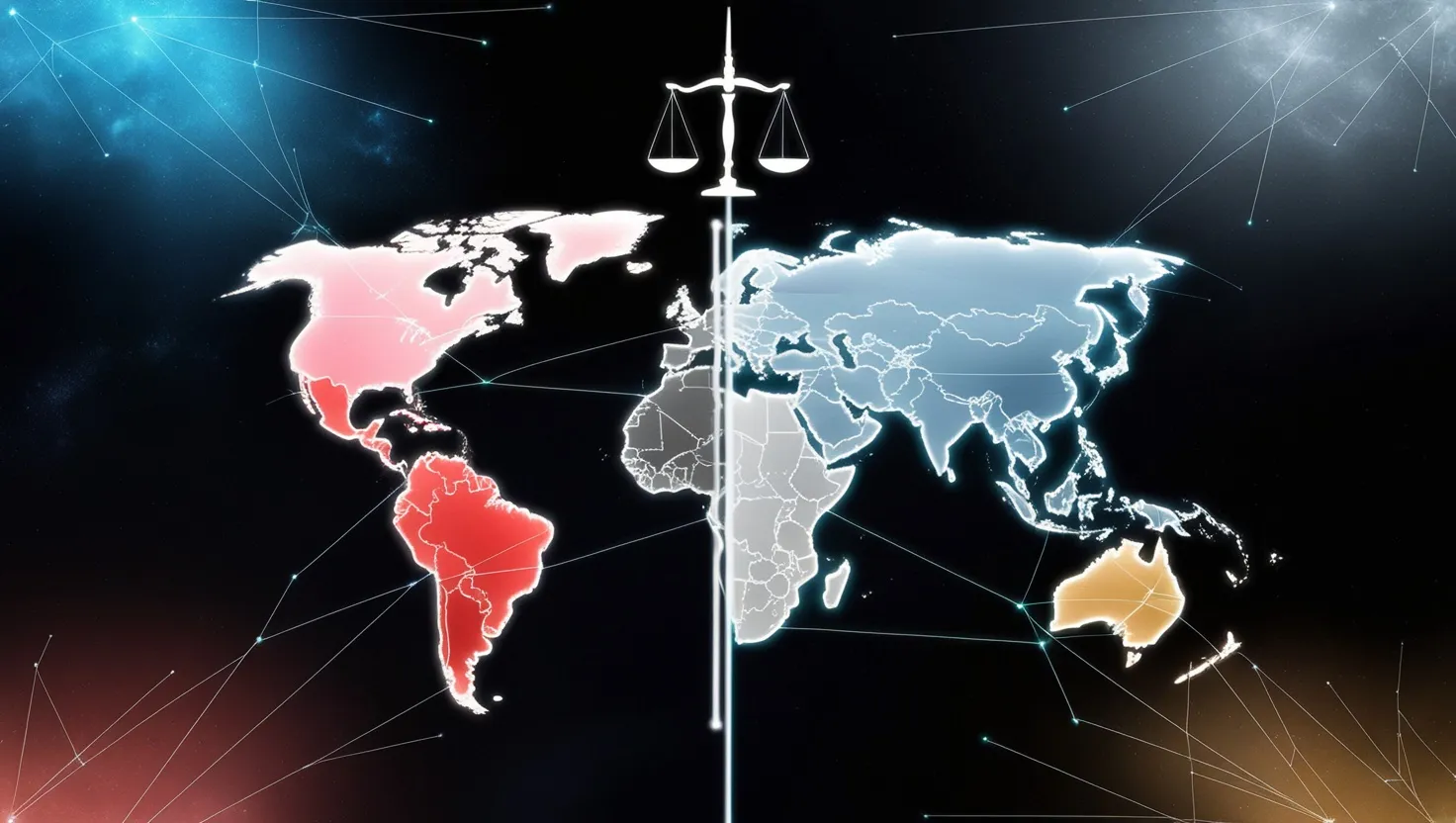
What you’re really watching, across all five of these frameworks, is a clash of values disguised as a policy debate. The EU prioritizes rights and safety. The US prioritizes innovation and market leadership. China prioritizes stability and sovereignty. UNESCO prioritizes inclusion and dignity.
None of these are wrong exactly — they reflect genuine trade-offs that every society has to make. The question is what happens when an AI product built under one framework gets used in a country governed by another. A hiring algorithm trained on US data, regulated under EU law, deployed in a country with no AI rules at all — who’s responsible when something goes wrong?
“In a time of universal deceit, telling the truth is a revolutionary act.” — George Orwell
The coming years will determine whether these frameworks converge into something coherent or fragment into competing blocs where companies simply route their products through whatever jurisdiction suits them best. That’s called regulatory arbitrage, and it’s already happening.
What you can do right now is pay attention to where your AI tools come from and what rules govern them. When a product says it’s “compliant” — ask compliant with what, and for whom. The rules being written today will define what AI does to your life tomorrow, and the more people understand them, the harder it becomes for anyone — governments or corporations — to write those rules purely in their own interest.