5 Indian Government Schemes Every Woman Entrepreneur Must Know Before Seeking Funding
Discover 5 government schemes designed for women entrepreneurs in India — from Mudra loans to DAY-NRLM. Find the right funding and start your business today.
Here’s something nobody tells you when you dream of starting a business — the money problem is not actually the biggest problem. The biggest problem is not knowing where to look for the money. Millions of women in India have skills, ideas, time, and genuine hunger to build something of their own. But they sit waiting, assuming the system wasn’t built for them. That assumption is wrong.
The Indian government has quietly built a set of financial programs specifically designed for women who want to start or grow a business. Not all of them are perfect. Not all of them work the way they’re supposed to every single time. But if you know how they work, you can use them. And that knowledge alone puts you ahead of most people who never even try.
Let’s walk through five of the most useful ones — not in a textbook way, but in a way that actually helps you figure out if any of them apply to your life.
The Loan That Asks for Nothing in Return (Except Repayment)
Mudra stands for Micro Units Development and Refinance Agency. That’s a mouthful. Forget the name. What matters is what it does — it gives loans to small business owners without asking for collateral.
Collateral means property, gold, or something of value that a bank can seize if you don’t pay back. Most traditional loans require this. Mudra doesn’t. That single difference changes everything for a woman who owns nothing on paper, even if she works harder than anyone in the room.
“A woman with a voice is, by definition, a strong woman.” — Melinda Gates
Mudra loans come in three sizes. Shishu covers loans up to ₹50,000. Kishore covers ₹50,001 to ₹5 lakh. Tarun covers ₹5 lakh to ₹10 lakh. If you’re just starting out, Shishu is your entry point.
How do you apply? Walk into any public sector bank, regional rural bank, microfinance institution, or small finance bank. Tell them you want a Mudra loan under the Pradhan Mantri Mudra Yojana (PMMY). Bring your ID proof, address proof, a passport photo, and a basic description of what business you plan to run. You don’t need a fancy business plan document. A simple handwritten explanation of what you sell or plan to sell is enough at the Shishu level.
Think about a woman who makes pickles and chutneys at home and sells to neighbors. She could use a Shishu Mudra loan to buy better packaging, a commercial-grade mixer, and raw materials in bulk. With that, she moves from selling 20 jars a week to 200. That’s a real business, and it started with a ₹30,000 loan and no collateral.
When You Want to Go Bigger — Stand-Up India
Stand-Up India is different from Mudra. It targets women who are ready to start something more structured — in manufacturing, services, or the trading sector. The loan range is ₹10 lakh to ₹1 crore. This isn’t a side hustle fund. This is serious business capital.
Each bank branch under Stand-Up India is required to give at least one loan to a woman entrepreneur. That’s written into the program’s structure. Banks can’t ignore it, even if loan officers sometimes make the process feel harder than it should be.
What do you need? A business plan. Not complicated, but real. You need to show that you plan to use the money for a new business (not an existing one) and that you belong to the SC/ST category or are a woman. The program covers both groups.
So, have you thought about what kind of business you’d start if money wasn’t the issue? Because for many women, this program can make that question very real.
The process runs through the Stand-Up India portal online, but you can also go directly to any scheduled commercial bank. The bank assigns you a loan officer who is supposed to guide you. If they’re unhelpful, try a different branch. Persistence matters here.
Selling Your Products Without Leaving Home
One of the quietest and most underused programs for women is Mahila e-Haat. It’s an online marketplace built specifically for women entrepreneurs and self-help groups. Think of it as a government-backed version of a selling platform — where women can list their products and sell to buyers across the country.
“You may not control all the events that happen to you, but you can decide not to be reduced by them.” — Maya Angelou
Who should use this? Any woman who makes something — handloom products, handicrafts, food items, clothing, accessories — and struggles to find buyers beyond her local market. Mahila e-Haat removes the need for a physical shop, a middleman, or expensive advertising.
Registration is free. You go to the Mahila e-Haat website, create a seller profile, upload photos of your products with descriptions and prices, and you’re listed. Orders can come from anywhere. This is especially powerful for women in smaller towns and rural areas who make beautiful, traditional products but have no way to reach city buyers willing to pay a fair price.
A woman weaving Madhubani art pieces in Bihar doesn’t need to know a gallery owner in Delhi. She just needs a smartphone, decent photos of her work, and a registered profile on Mahila e-Haat.
Saving Money for Your Daughter’s Future — Which Also Builds Your Own
Sukanya Samriddhi Yojana is technically a savings scheme, not a business loan. But if you’re a woman thinking about business and you have a daughter under 10 years old, this matters to you deeply.
You open an account for your daughter with as little as ₹250 a year. The interest rate is one of the highest offered by any government savings scheme — around 8% per year, compounded annually. The maturity amount comes when your daughter turns 21 or gets married after 18.
Why does this connect to entrepreneurship? Because one of the hidden costs of running a business is anxiety about your family’s financial future. Women who have a secure savings plan for their children make bolder business decisions. They’re not pulling money out of the business for emergencies because they’ve already created a safety net elsewhere.
Open the account at any post office or authorized bank. Bring your daughter’s birth certificate, your own ID, and your address proof. The annual deposit can be as low as ₹250 or as high as ₹1.5 lakh — whatever suits your situation.
The Power of Women Standing Together
DAY-NRLM — the Deendayal Antyodaya Yojana National Rural Livelihoods Mission — is built around one idea: women are stronger in groups than alone.
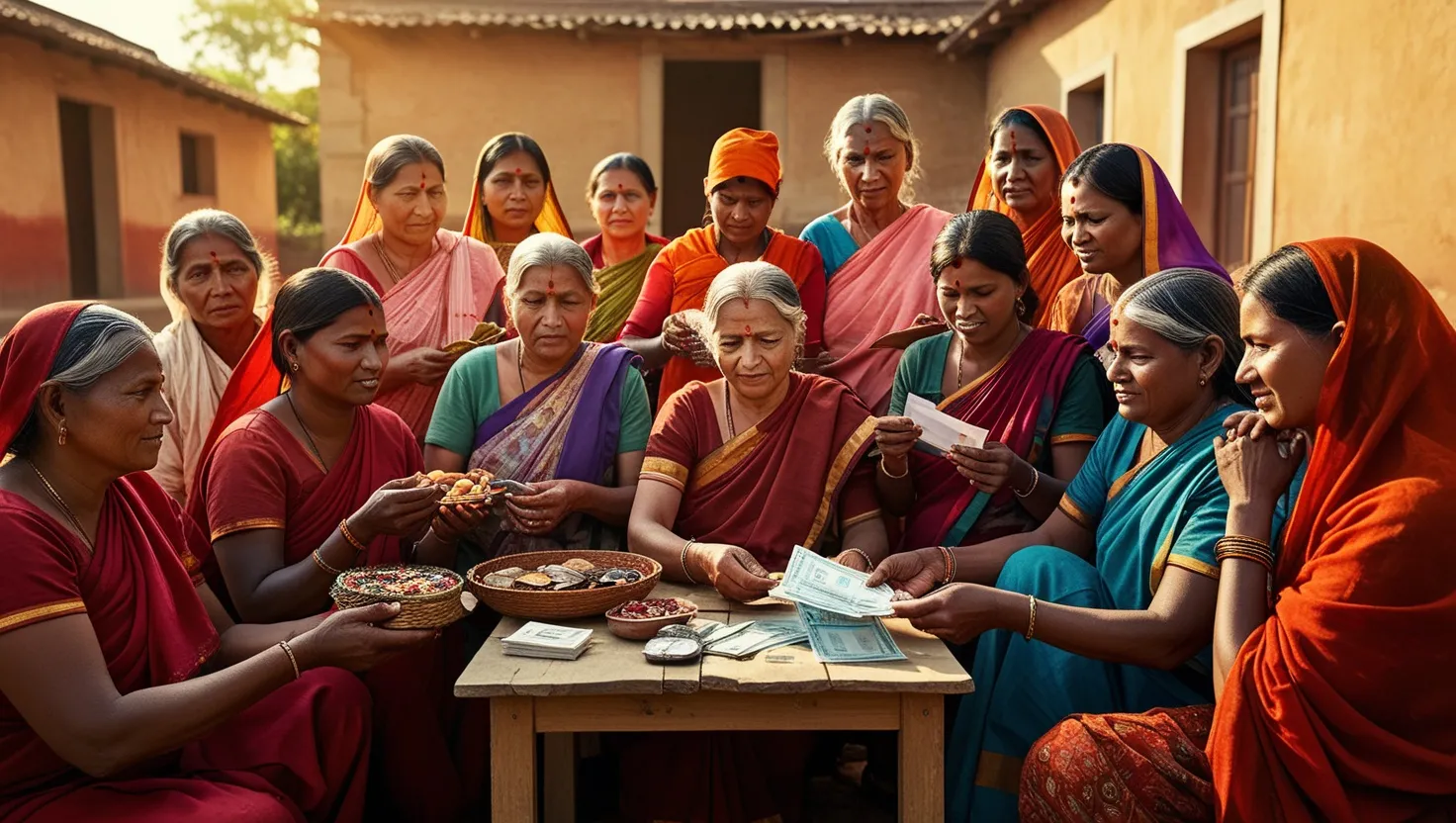
The program organizes women into Self-Help Groups (SHGs). Each group typically has 10 to 15 women. They meet regularly, save small amounts together (even ₹10 or ₹20 per week), and build a common fund. This collective savings amount can then be borrowed by any member at a low interest rate to start or expand a small business.
“I have learned over the years that when one’s mind is made up, this diminishes fear.” — Rosa Parks
The revolving fund concept is simple — one woman borrows, repays, and another borrows. Over time, SHGs also become eligible for bank credit linkage, meaning banks offer formal loans to the group. The track record of SHGs for loan repayment in India is genuinely impressive, which is why banks trust them.
How do you join? Contact your local village panchayat, block office, or the NRLM office in your district. In most rural and semi-urban areas, SHGs are already active and looking for new members. In some areas, the government itself organizes outreach to recruit women. Ask around in your neighborhood — chances are one of your neighbors is already in a group.
Do you know what the most underused resource in any of these programs is? The people running them. Loan officers, SHG coordinators, bank managers — many of them have budgets to disburse and targets to meet. They need applicants as much as applicants need them. Walking in prepared, with documents and a clear idea of what you want, changes how you’re treated.
The gap between these programs existing and women actually using them is largely a gap in information. A woman making handmade candles from home, a woman selling homemade snacks at the school gate, a woman who has been weaving baskets her whole life and never thought it could be a real business — all of them qualify for at least one of these programs.
“The question isn’t who’s going to let me; it’s who’s going to stop me.” — Ayn Rand
Government programs are not charity. They are financial tools. Like any tool, they work only when you pick them up. These five — Mudra loans, Stand-Up India, Mahila e-Haat, Sukanya Samriddhi Yojana, and DAY-NRLM — cover credit, market access, savings, and community capital. That’s nearly every financial need a woman entrepreneur faces.
Start small if you must. Open a Sukanya account this week. Visit your nearest bank and ask about Mudra. Look up Mahila e-Haat and see if your products fit. These are small actions with genuinely large outcomes, and the only thing standing between you and the first step is deciding to take it.