India's Rail Revolution: 5 Real Changes Making Daily Commutes Faster and Less Painful
Discover 5 real rail upgrades transforming Indian commutes — from Vande Bharat routes to new metros. Learn how to book smarter and travel better. Read now.
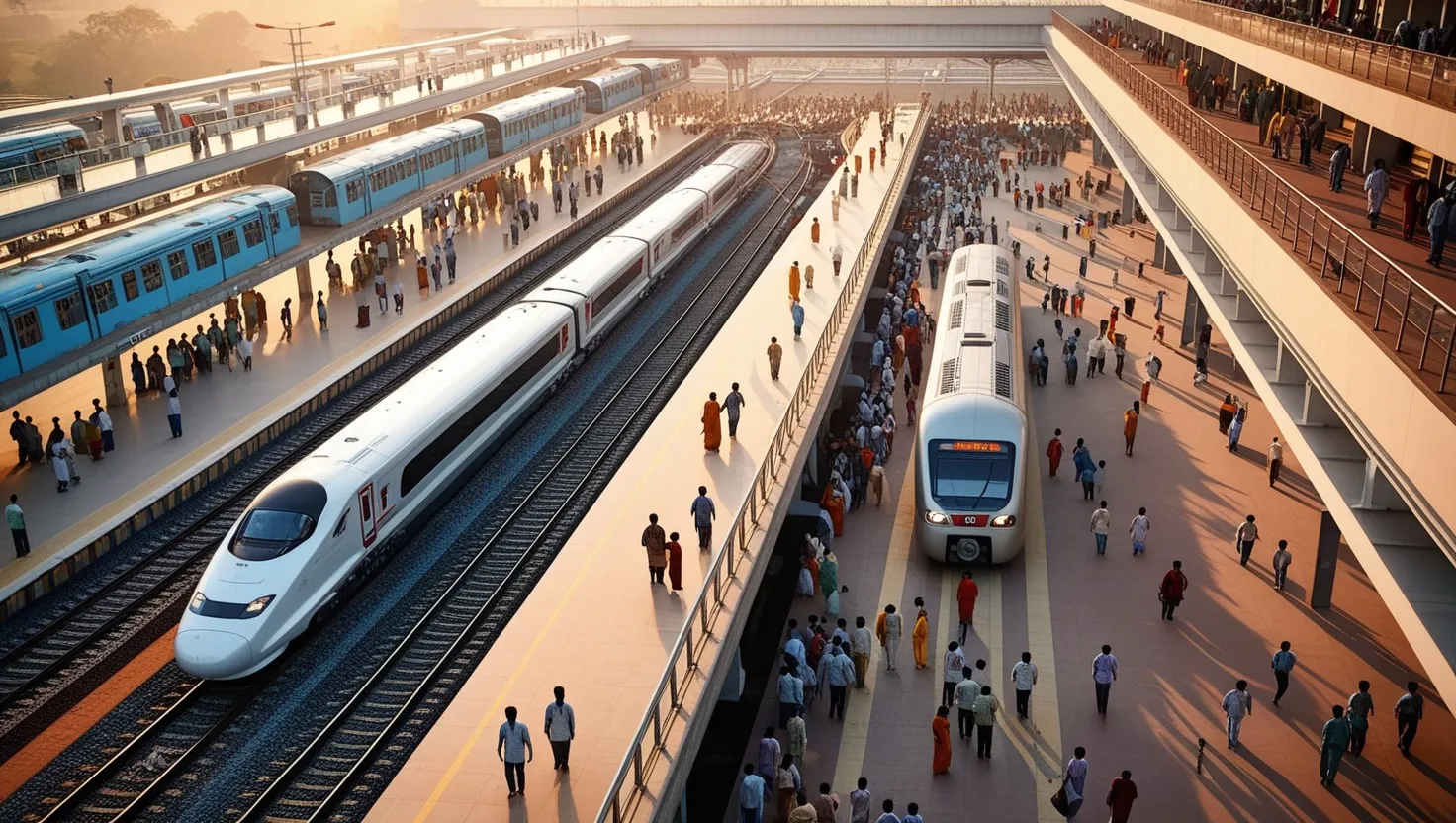
If you have ever stood in a sweaty, overcrowded train compartment, watching the clock tick while you counted the minutes until your stop, you already understand why rail infrastructure is not just a policy matter — it is a daily survival skill. Millions of Indians wake up every morning and mentally calculate whether today will be the day the system finally works in their favor. The good news? In several corners of the country, it actually is. Let me walk you through five real, happening-right-now changes that are quietly reshaping how ordinary people get from one place to another.
Vande Bharat Trains Are Not Just for Long Distances Anymore
Most people still picture Vande Bharat as that sleek, white train connecting major cities like Delhi and Varanasi or Chennai and Bengaluru. But the network has expanded into something far more interesting — shorter, inter-city routes that used to be absolute nightmares.
Think about the Mysuru-Chennai corridor, or the Pune-Hubballi stretch. These are routes where a three-to-four-hour journey used to eat half your workday. Vande Bharat has trimmed those significantly. The train’s ability to accelerate and decelerate faster than conventional trains means it does not lose as much time at intermediate stops. That is a technical detail most passengers never think about, but it shows up in the schedule as twenty to forty minutes saved — and that adds up to real life.
The booking angle here is simple: Vande Bharat tickets open on the IRCTC app sixty days in advance. Tatkal opens one day before departure. The trick most people miss is that Tatkal on Vande Bharat is still cheaper than tatkal on many older trains in the same class, because the base fare structure is different. If you are flexible on timing, book at midnight when the quota refreshes. For regular commuters using Vande Bharat on weekly routes, IRCTC’s monthly pass options for select corridors are worth checking — they are under-advertised and genuinely save money.
“The railway is a great social equalizer — it carries the peasant and the peer, the beggar and the baronet.” — Anonymous Victorian railway observer
Metro Lines Are Finally Reaching Cities You Would Not Expect
Here is a fact that surprises most people: Patna now has an operational metro. So does Indore. These are not tier-1 giants. These are cities where, until very recently, the daily commute meant either a crowded auto-rickshaw, a shared tempo, or sitting in traffic that seemed to have no beginning and no end.
Patna Metro’s first operational corridors are already changing behavior. People who used to plan their entire morning around beating peak-hour traffic are now walking ten minutes to a station and arriving at work without the psychological damage of a terrible commute. Indore’s metro has integrated surprisingly well with the city’s already decent bus network, which is something other metro systems took years to figure out.
What makes these tier-2 metro systems interesting is their design philosophy. They are being built with lessons learned from the Delhi and Mumbai Metro’s early-phase mistakes — overcrowded single-corridor systems, poor last-mile connectivity, and stations that were hard to access without a car. Patna and Indore’s planners have consciously built intermodal transfer points into the initial design, not as an afterthought.
If you live in or travel to these cities, here is something practical: the Metro apps for these cities are available on Android and iOS and offer real-time train tracking. Ticket vending machines accept UPI, which solves the change-problem that plagued older metros for years. Smart card loading is also available at station counters.
The Integrated Bus-Rail Hub — Boring Name, Big Deal
Most people walk past the phrase “integrated multimodal hub” on a news website and immediately scroll away. Fair enough — it sounds like bureaucratic furniture. But think about what it actually means for a commuter.
You get off a train. Instead of fighting your way through a chaotic parking lot, walking half a kilometre to a bus stop, and then realizing the bus you need left three minutes ago, you step onto a covered walkway, follow clear signage, and board a connecting bus whose schedule is synchronized with the train’s arrival. That is the idea. And in a few places in India, it is actually working.
Chennai’s CMBT-MRTS integration has improved significantly. Bengaluru’s Majestic interchange, long notorious for its chaos, has been reorganized to reduce the walking distance between metro and bus by nearly 60%. Hyderabad’s new Secunderabad multi-modal hub is connecting MMTS suburban trains, city buses, metro feeder services, and intercity buses under one roof with a single integrated ticketing system in development.
“The measure of a city’s civilization is not its monuments, but the ease with which its ordinary citizens move through it.” — Attributed to urban planner Lewis Mumford
Does the integrated hub work perfectly everywhere? No. But the direction is right. If you are planning a trip that involves multiple modes, check the ONDC-based mobility apps or Google Maps’ transit mode — both are now updated with multimodal routing for most major Indian cities and give you real walking times between interchanges, not optimistic estimates.
AC Suburban Trains in Mumbai and Bengaluru — What Actually Changed
The Mumbai AC local has been running for a while, but usage picked up dramatically only after two things happened: the ticket price became more reasonable relative to ordinary first-class fares, and the reliability of air conditioning actually improved. Early on, you had AC locals where the AC was a theoretical concept. Now, the service is genuinely more consistent.
In Bengaluru, the suburban rail project — long delayed and much criticized — has started its first operational phase connecting KSR Bengaluru station to Whitefield and Kengeri. This is a city that has been screaming for suburban rail for two decades. The early frequency is modest, but the foundation is there. Commuters on the Whitefield IT corridor who currently spend ninety minutes in traffic each way are already calculating whether a ten-minute drive to the nearest suburban station plus a thirty-five-minute train ride changes their lives. Mathematically, it does.
For Mumbai, the smart move is to get a central railway’s QR-based mobile ticket for AC locals. You skip the counter queue entirely, which during peak hours in stations like Dadar or CST is not a small thing. For Bengaluru suburban, the UTS app — the Unreserved Ticketing System — works for suburban bookings, and paper tokens are available at stations with Rupay and UPI acceptance.
One commuter’s experience is worth thinking about here: a software professional commuting from Thane to Lower Parel switched from road to AC local and recovered about seventy-five minutes daily. Over a working month, that is roughly twenty-five hours returned to his life. That is not a small number.
Redeveloped Stations — What the New Design Actually Does for You
The station redevelopment program gets covered mostly through photographs of shiny new facades, which misses the more practical improvements happening inside. Accessibility is the real story.
Stations like Gandhinagar, Rani Kamlapati in Bhopal, and the redesigned Ayodhya Dham station now have proper lift access on every platform, tactile paths for visually impaired passengers, wider concourses that reduce crowd crush, and waiting areas that are actually air-conditioned rather than theoretically air-conditioned. Rani Kamlapati specifically has a well-functioning food court inside the secured waiting area, which means you are not choosing between eating and sitting in a safe zone.
The practical use tip here: most redeveloped stations now have pre-paid taxi and cab aggregator pickup zones that are clearly demarcated and separated from the main entrance chaos. Using these rather than the general exit saves meaningful time and reduces the harassment from unlicensed operators.
“A good traveler has no fixed plans and is not intent on arriving.” — Lao Tzu
For passengers with mobility needs, the IRCTC divyaang concession booking now links directly to station accessibility information for redeveloped stations, so you can check in advance whether the specific platform your train uses has lift access.
There is a version of rail travel in India that your parents or grandparents would not recognize — not because it has become luxurious, but because it has become less punishing. The commuter saving an hour a day on Vande Bharat, the family reaching their weekend destination without the familiar train-delay misery, the first-time metro user in Patna who never imagined her city would have this — these are not statistics. They are the actual point of all this infrastructure work.
The system is far from perfect. Delays still happen. Overcrowding is still real on many routes. But knowing which tools exist, where to book, what to download, and which routes have genuinely improved is the difference between being at the mercy of the system and using it on your own terms.