Transform Household Chores Into Currency Games: Teaching Economics Through Colored Token Systems
Transform household chaos into cooperation with colored token chore systems. Learn how currency-based rewards teach kids economics, negotiation, and responsibility while making cleaning fun.
Chaos often sneaks into families with young children faster than socks vanish from the laundry. I remember reading once, “To bring up a child in the way he should go, travel that way yourself,” and that wisdom holds true for household dynamics. When life felt like a whirlwind for us—endless work emails, sticky countertops, and kids who seemed immune to the words ‘your turn’—my partner and I knew something had to change. Routine chore charts weren’t cutting it. Reminders sounded like background noise. We wanted something both practical and, dare I say, a little magical.
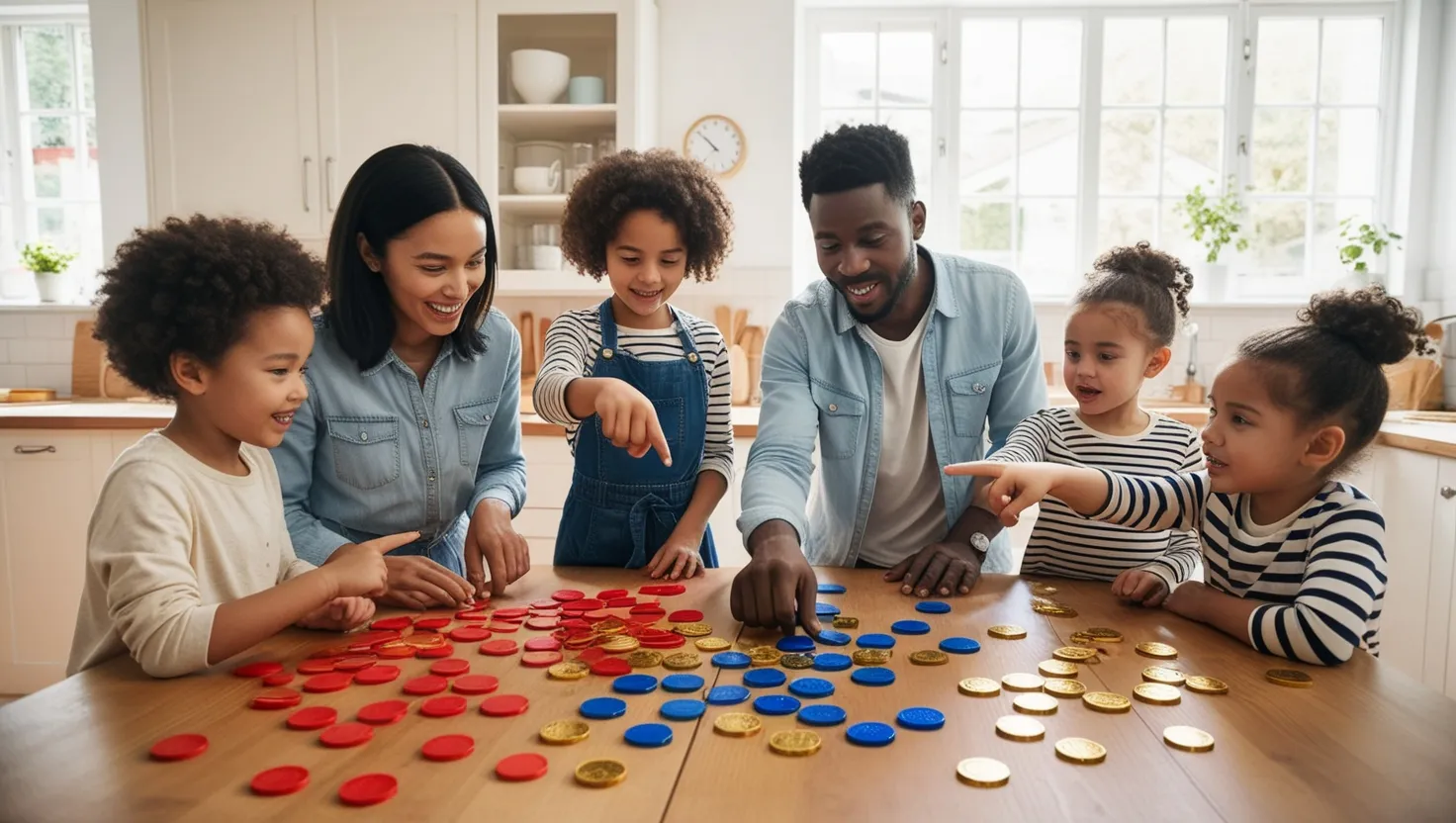
That’s how the colored token idea took shape. Instead of simply giving points or stars for chores, every task—big or small—earned one of several colored tokens. The catch? Each color had a different value, just like currencies in the real world. Red might be more valuable than blue, but less than gold, making every household job a mini lesson in choices and priorities. Can you picture the negotiation at the kitchen table? “If I trade you two blues for a red, I’ll have enough for that movie night, right?” Suddenly, our living room had the energy of an open market, with eager, pint-sized participants learning not just how to sweep the floor, but how value fluctuates according to what you want and how hard you’re willing to work.
It was fascinating to see our kids—usually engaged in sibling squabbles—bond over the new system. They started strategizing together, pooling colored tokens for joint rewards, and even discussing clever ways to split chores for the best payouts. The oldest, ever the tactician, proposed a family ‘exchange rate’ meeting every Friday, deciding whether reds should be worth more this week, or if a surprise gold could be introduced. The tokens turned into more than a labor incentive; they sparked real conversations—sometimes heated, sometimes hilarious—about fairness, effort, and the invisible forces that make things “worth it.”
Curiosity took over where complaints used to brew. Questions popped up during dinner: Why does one country’s money buy more than another’s? Do grownups ever swap what they earn for other currencies? I realized that what started as a parent survival hack had become a rare kind of classroom, one where exchange rates, opportunity cost, and negotiation became second nature. How often does emptying the dishwasher lead a kid to wonder about the price of chocolate in Paris?
“Tell me and I forget, teach me and I may remember, involve me and I learn.” Benjamin Franklin’s timeless observation echoed in my mind. When children participate—when lessons become tangible and choices carry small, satisfying consequences—they learn in ways that stick. Ask yourself: When was the last time a textbook or a lecture felt as memorable as a real, lived experience at the kitchen table?
This experiment also reshaped how my partner and I saw household labor. We stopped viewing chores as merely a box to check or a hurdle for the week. Instead, they felt like a bridge—parents and kids working toward mutual rewards rather than separate, silently competing agendas. Saturday mornings, once tense with reminders and groans, now sound more like cheerful banter and patient bartering. The room fills with math problems disguised as trades, laughs over half-completed tasks, and the pride that comes with sharing a win—be it a home movie night or homemade pizza for all.
Have you ever thought about how much cultural knowledge we bundle into seemingly simple habits? This token system is, in a way, an introduction to global citizenship. Kids might be too young for the bureaus of foreign exchange, but here, at home, they’re getting hands-on with the idea that value can be relative, not fixed. Two children, two approaches: One might hoard tokens for a hefty future reward, learning about saving and patience, while the other spends quickly for smaller, instant pleasures, experiencing tradeoffs firsthand. As parents, we get a window into their thinking—what feels ‘worth it’ to them, and why.
Even the arguments became opportunities. “Why does taking out the recycling earn less than vacuuming?” one asked, hands on hips. These debates led us to real discussions about labor, effort, and social agreements. Who decides what something’s worth? Isn’t that what markets do, whether it’s chores or global currencies? If a family chore can lighten up conversations about inflation and relative value, are we planting the seeds for a lifetime of financial curiosity—and maybe, just maybe, a little less eye-rolling when chores come around?
“Children are not things to be molded, but are people to be unfolded.” This Maria Montessori quote rings especially true here. Instead of only teaching our kids to follow rules, we give them room to question, negotiate, and, yes, occasionally challenge the system. That doesn’t mean every day is smooth sailing. Tokens get lost. Someone tries to trade in a token for something off-limits (“Is there a special prize if I vacuum without being asked?”), and negotiations can get a bit heated, much like the grown-up world of currency speculation. But that’s part of the value—real stakes and real consequences in a low-risk environment.
The real prize isn’t just a cleaner house, though I’ll admit, that’s a nice side effect. It’s the daily discovery that responsibility can feel empowering rather than burdensome. When kids see a direct connection between their effort and their goals, they develop a sense of control—a belief that their choices matter. How many adults still struggle with that feeling at work or in their finances? Why not give kids a head start?
I’ll admit, not everyone in my circle was sold on this at first. Some worried that turning chores into transactions would undercut intrinsic motivation, or that kids would demand payment for every little act of help. But what I’ve found is that transparency and negotiation build trust. Kids know that sometimes, families do things simply because we care for each other—and that’s a conversation we revisit often, especially when tokens aren’t on the table. Even in those moments, the language of value stays alive: Is helping a sibling, even when no one’s watching, worth a secret ‘bonus’ token or an extra bedtime story? Sometimes, yes.
Our system has evolved as the kids have grown. The tokens might change in color or design, the chores scale up with their ages, but the lessons stick. There’s usually that moment at the end of a long week—tokens counted, rewards chosen, tired parents watching proud kids—when someone says, “Should we change the rates again next week?” And I think to myself: this isn’t just about household logistics or even economics. It’s about nurturing a spirit of curiosity, negotiation, and togetherness.
“Education is not the filling of a pail, but the lighting of a fire.” W.B. Yeats captured in words what these colored tokens bring to our family life. Isn’t the ongoing spark of learning, the transformation of chores from a battleground to a game board, a fire worth kindling, week after week?
So I turn the question to you: What small changes could bring more cooperation and discovery to your daily routine? If chores feel like a battleground, could a few colored tokens transform the landscape? Try it for a week, and see which conversations surprise you; the real reward might be something you didn’t expect.
In the end, when everyday tasks become a family adventure, the lessons go far beyond clean counters and empty garbage bins. They travel with us—into how we communicate, solve problems, and see each other’s strengths. And if those lessons come in the form of purple tokens and late-night popcorn parties, I’m fairly certain that’s a trade worth making.